2021 Reads

This is by no means an exhaustive list of my 2021 reads, but since it is getting close to the start of a new year (presumably when people make resolutions to read more widely), I will pick a handful that I think are worth your time. They are listed in no particular order.

  • Everything Sad Is Untrue by Daniel Nayeri
  • Finding Langston by Lesa Ransome-Cline
  • What Happened to You? Conversations on Trauma, Resilience, and Healing by Dr. Bruce Perry and Oprah Winfrey
  • Skunk and Badger by Amy Timberlake
  • Where Stars are Scattered by Victori Jamieson and Omar Mohamed
  • Disability and the Church: A Vision for Diversity and Inclusion by Lamar Hardwick
  • Jacksonland: President Andrew Jackson, Cherokee Chief John Ross, and a Great American Land Grab by Steve Inskeep
  • Prayer in the Night: For Those Who Work or Watch or Weep by Tish Harrison Warren
  • On the Spectrum: Autism, Faith, and the Gifts of Neurodiversity by Daniel Bowman, Jr.
  • Talking Back to Purity Culture by Rachel Joy Welcher
  • Dog Songs and A Thousand Mornings by Mary Oliver
  • Wintering: The Power of Rest and Retreat in Difficult Times by Katherine May
  • The Children of Men by P.D. James
  • This Too Shall Last by K.J. Ramsey
  • The Warmth of Other Suns by Isabel Wilkeron
  • Farewell To Manzanar: A True Story of Japanese American Experience During and After the World War II Internment by Jeanne Wakatsuki Houston
  • Turning of Days : Lessons from Nature, Season, and Spirit by Hannah Anderson
  • The Sum of Us: What Racism Costs Everyone and How We Can Prosper Together by Heather McGhee
  • The Code of the Woosters by P.G. Wodehouse
  • A Walk in the Woods by Lee Blessing


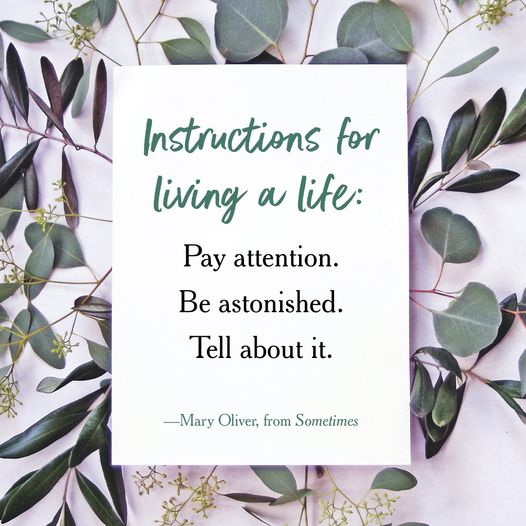
Be Astonished


If you’ve never read Mary Oliver’s poetry, you’re missing out on the sublime. I can say this because for most of my life I haven’t been a patient person with poetry. I don’t recall it being taught to me with joy, often only purpose and meaning. I thought it always needed to steep in my mind for it to be worthy of consideration. The economy of words it required made me feel insecure about forming a decent interpretation. I hate admitting that. I feel the weight of guilt — literature majors are supposed to have an innate love of the word in all forms, right? It wasn’t until I understood that poetry could simply be approached with delight (as opposed to only seeking joy in the clever meaning or rhythm) that things started to change course. I thought and taught differently.

Enter Mary Oliver. She just passed away in 2019 and was eulogized like this:

“Mary Oliver isn’t a difficult poet,” Franklin says. “Her work is incredibly accessible, and I think that’s what makes her so beloved by so many people. It doesn’t feel like you have to take a seminar in order to understand Mary Oliver’s poetry. She’s speaking directly to you as a human being.”

Oliver told NPR that simplicity was important to her. “Poetry, to be understood, must be clear,” she said. “It mustn’t be fancy. I have the feeling that a lot of poets writing now, they sort of tap dance through it. I always feel that whatever isn’t necessary should not be in the poem.”

Oliver’s world is simultaneously whimsical and serious without melodrama. Her collection called Dog Songs could be read to all ages and guaranteed to produce more than a few tears of joy and grief. I started reading these poems with the Maple Key girls and the anticipation is high on which of Mary’s canines we will have the pleasure of meeting next week.

God bless you, Mary. If somebody had told me about you when I taught high school, I would have read you every day to my class. The world is a bit sadder without your wholehearted presence speaking to our tender souls.

Lament and Gratitude

The end of the school year is has come. Last night the girls performed their Shakespeare with friends or showed their various coordinated dances. They all said they are sad to not see their buddies so often, but are excited to be home and have lots of unstructured time this summer.

In reflecting on life after another school year, I opened my commonplace book where I write down quotes from books I’m reading. One passage I wrote was talking about why teachers teach specifically (but I think the sentiment applies to engaging with humanity in general), saying, “You must do without the traditional pedagogic luxury of believing that the people you teach are lazy, rude, or entitled. You do it instead, knowing that they are all straining under the load of their own grief.”

It reminded me of a conversation with a friend about how a gratitude journal and a lament journal go hand in hand. We agreed you can’t see either thing rightly unless you can acknowledge both. If everything’s about gratitude then you have to hide the hard things. If everything’s about the hard things, then you find nothing to be grateful for. I know all too well which side I err on. My prayer is that God would continue to show us those who are straining under the load of their own grief so we can be salt and light in a heavy world. And once we see them that we would not turn away from them, but instead first do our own heart work to be able to give in abundance and service.